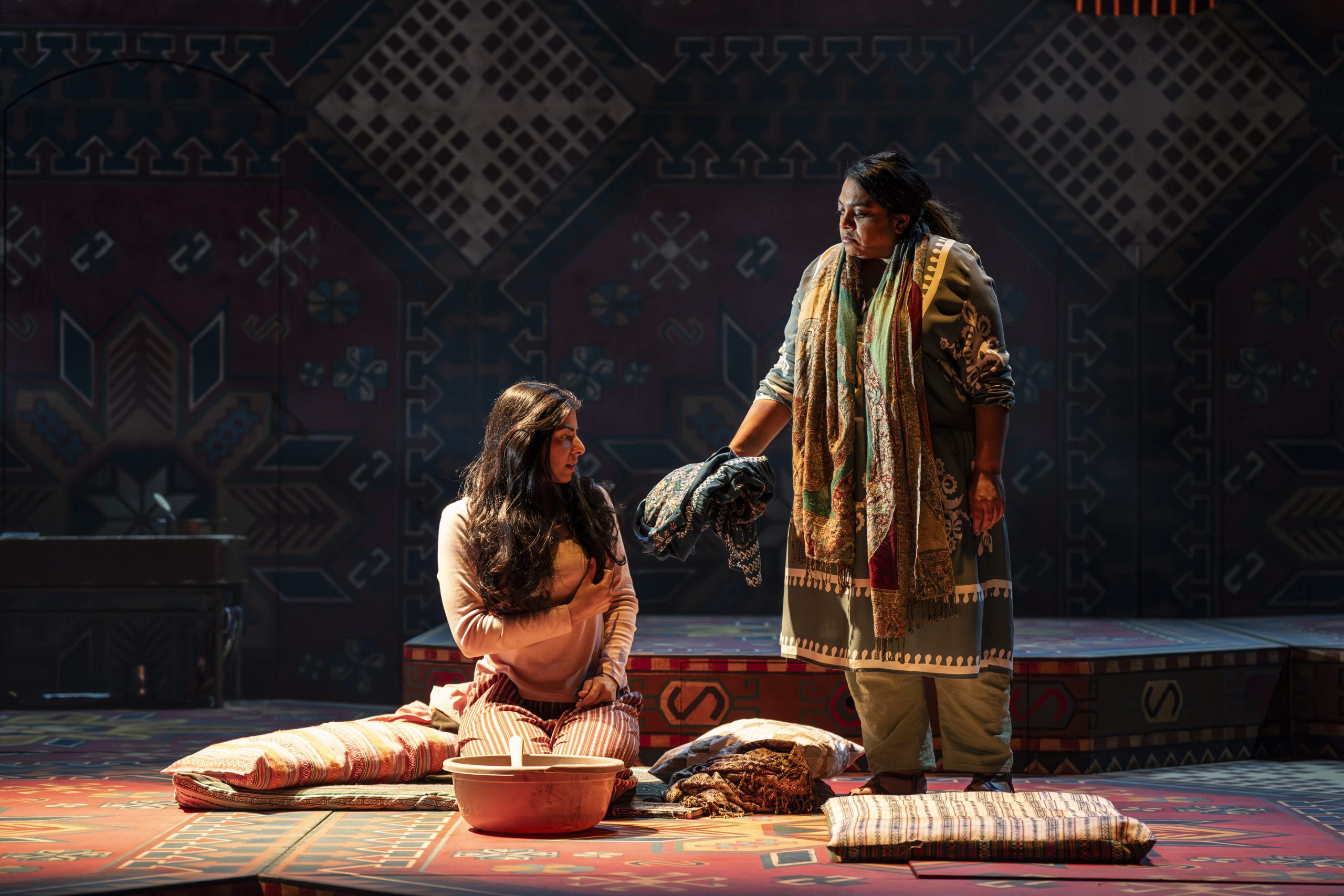
Following his debut novel Kite Runner published in 2003, Khaled Hosseini’s A Thousand Splendid Suns is a story of a mother/daughter relationship, in contrast to his first novel that focuses on the complexities of a father and son relationship. Hosseini’s second novel explores women’s position in both home and society, primarily centred between the two main characters Laila and Mariam. I was intrigued and excited to see as to how such a powerful and emotionally charged novel would transfer onto stage, and how such difficult themes would capture the audience’s imagination the way the novel did when I read it in 2007 and multiple times since. In order to appreciate the adaptation of the play, you have to remind yourself that this is a story unfolding on stage in a short space of time. Though many scenes are not included in the play, the adaptation effectively explores all the themes from Hosseini’s novel.

The play opens to an emotionally charged scene, where Laila and her parents are frantically packing their cases as the country around them is ravaged by rockets. There are brief instances in the play that manage to capture light-hearted scenes, poignant, and sometimes humorous moments— a much needed respite from otherwise traumatising themes as the story unfolds.

Playwright Ursula Rani Sarma, successfully manages to convey that even as the characters lives quite literally titter on the edge of destruction, there are rare moments of humour and poignancy to be experienced. Such a moment arrives very early on in the play when Laila’s father can not quite decide on which of his beloved books to take with him as they plan to escape for Pakistan.

The title of Hosseini’s novel A Thousand Splendid Suns originates from the poem written by the Iranian 17th-century poet Saib-e-Tabrizi. As Laila helps her father pack his much loved books she takes a moment to sit with him and poignantly read from the book in his hand:
“One could not count the moons that shimmer on her roofs,
or the thousand splendid suns that hide behind her walls.”

The title of the book is an ode to Afghanistan which perfectly captures the essence of the novel and the importance of moving forward as a country and how destructive familial relationships can become under the extremities of war and the tyranny of Taliban rule, therefore obliterating the progress the country had made in regards to education for girls and opportunities for women.

The themes and issues explored in both novel and play are even more relevant today as there were when the novel was based. The story is set against the backdrop of a complicated history of a country’s occupation, first by the Soviets, then the rule of the Mujahideen to finally the tyranny of the Taliban. The novel and play are by no means an exploration on the complicated politics of Afghanistan, rather it focuses on how the impact of war can have on individuals who are making the best of a very complicated and complex political situation.

At the heart of the play is the relationship that develops between two unlikely allies Mariam and Laila played by actresses Rina Fatania and Kerena Jagpal. Stage-setting, special effects and music effectively lend a hand to capturing the emotionally charged themes throughout the play. Some scenes are extremely traumatising to watch but necessary in order to effectively convey the themes of domestic violence, suicide and the onslaught of war and the terrifying presence of the Taliban.

Mariam’s mother Nana played by Peyvand Sadeghian, hanging herself is both harrowing but imperative in order for the audience to understand how women can be permanently scarred by the abuse they are subjected to—first at the hands of men—and subsequently society.

The scenes of violence and despair are padded out by scenes of humour, that accurately display human nature’s need for emotional escapism that can be found within female connections and bonds created within a society that blurs the lines between religion and patriarchal rule.

The presence of the Taliban armed with rifles is both foreboding and alarming with a stark realisation to the audience that women and girls are still subjected to their tyranny today. Flashbacks from Mariam and Laila offer context to their backstories and insight into their present situation. Grief, fear, love unite two women in a fight against tyranny and freedom for both their children—their daughter so she doesn’t endure any further suffering and the same oppression that they have, and their son who doesn’t grow up mirroring his father’s violent and oppressive behaviour towards women.

Leeds Playhouse
A Thousand Splendid Suns
Quarry Theatre, Leeds Playhouse
28 May-14 June
14+
2hrs 30mins
Box office 0113 213 7700
Book online at leedsplayhouse.org.uk